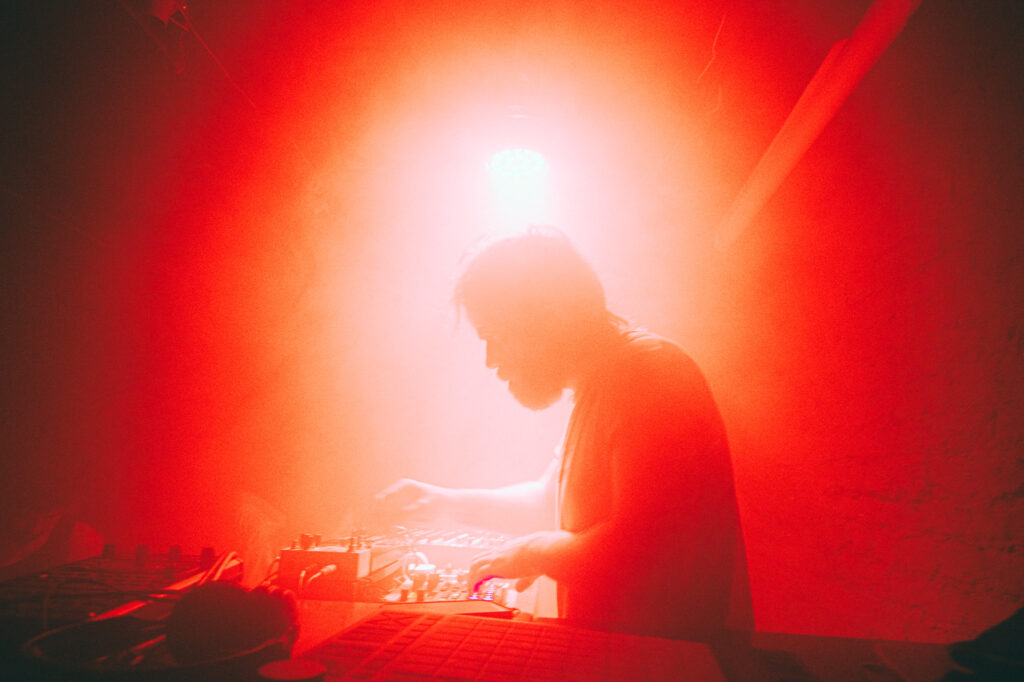
What are raves like in war-torn Ukraine? Kyiv’s ethno-rave resistance is bringing a sense of national identity and tradition back to the country
By Edwin Fairbrother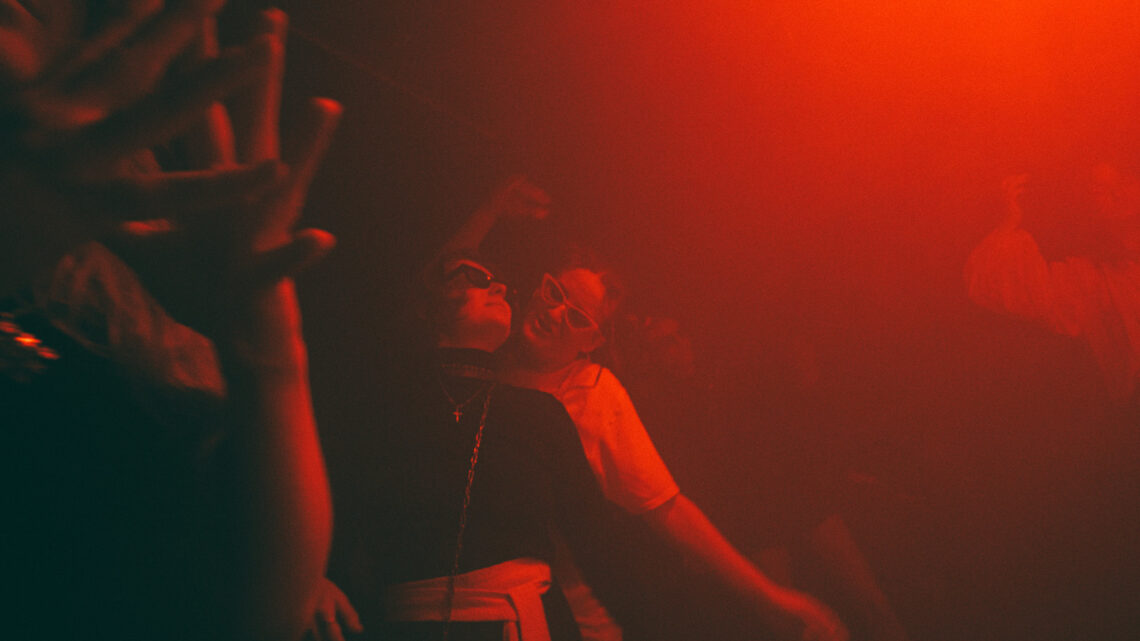
Scene Report: CMYK & Kyiv’s Ethno-Rave Resistance
It’s not news to anyone that Ukraine has been the victim of a brutal war over the last 3 years, severely disrupting day to day life, causing untold damage to its cities and infrastructure, and unfortunately resulting in the deaths of thousands of Ukrainian soldiers and civilians.
That said, the unshakable morale, resolve and perseverance of the Ukrainian people can only be commended. This resolve hasn’t just been manifested through military means, but through the art and music of creatives in Ukraine – many of whom are using their creativity to directly support the military (more on that below).
So, how is music being used as a force of resistance? How have music scenes changed since February 2022? And what are raves actually like in war-time Ukraine? Read below for answers to all these questions…
Zbyten – artists bringing a sense of Ukrainian identity and tradition back to the country after years of cultural suppression and war…
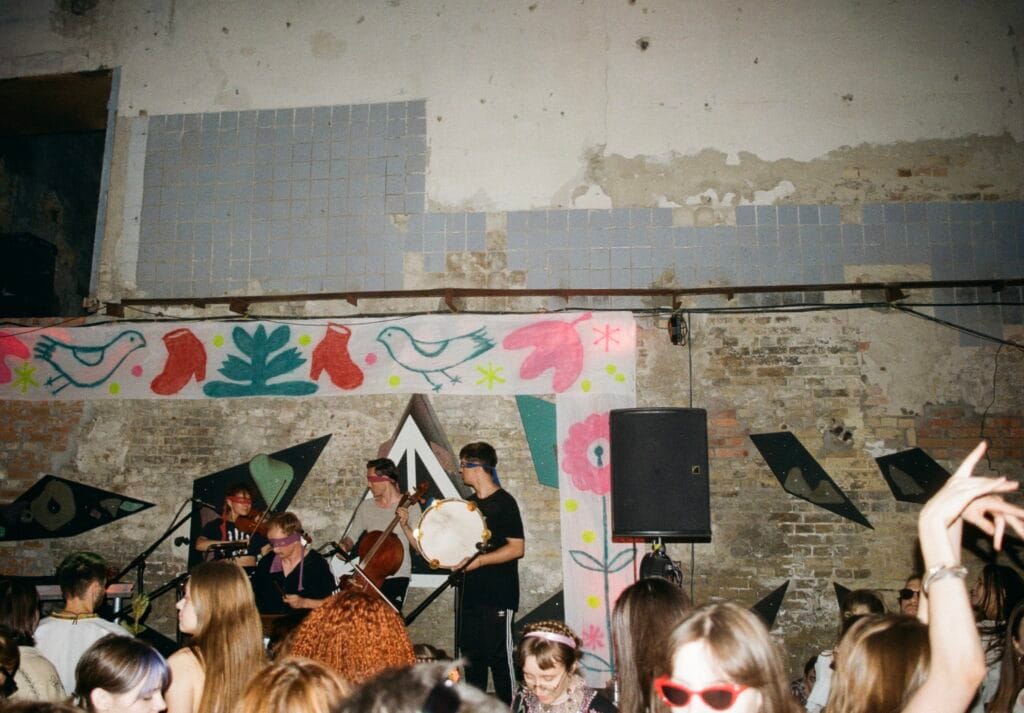
Traditional Ukrainian folk band turned ethno-rave outfit Zbyten was formed gradually over time, starting back in 2019. At first the group functioned as an ordinary trio, and later performed under the name ‘ShchukaRyba’.
After ceasing cooperation with the previous participants in 2021, the band acquired its current name – Kapela (meaning “band”) Zbyten – while upholding its main goal: “the development and popularization of the tradition of Ukrainian dance.” It was that year that the band also brought traditional Ukrainian dance to Alley of Artists – holding open-air parties in Kyiv’s creative hub that brought traditional music out of the underground, turning into somewhat of a cult event.
In 2024, with the addition of the bands DvaTry, Balamuty and Roksolaniia, these dances became regular events. That same summer, the current line-up of the Kapela was finally formed: Sofiia Helanok (fiddle), Viktor Perfetskyi (tsymbaly), Yurko Moskaliuk (frame drum), Andrii Paslavskyi (bass), and Klym Palii (fiddle, frame drum).
Today, Zbyten actively plays at dance events at the Alley of Artists, and at the Spaska 13 cultural centre (during the cold season); as well as at festivals, weddings and parties – continuing to keep Ukrainian traditional dance music alive by fusing it with modern EDM.
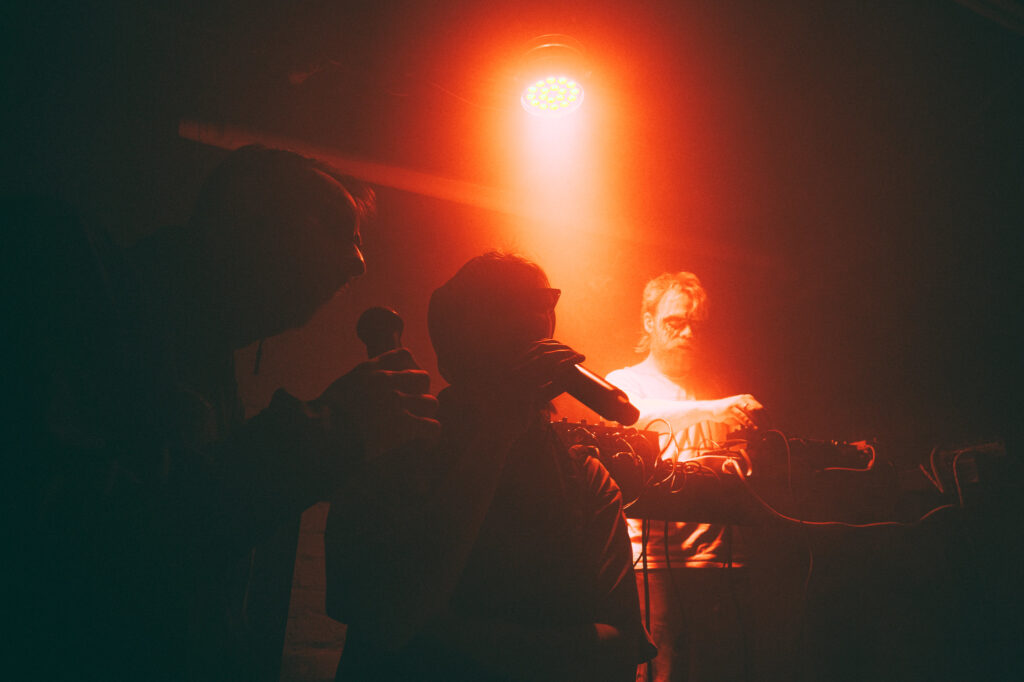
SoundScout Magazine spoke with Zbyten members Andrii and Klym, as well as rave organiser Lisa from CMYK about the developing ethno-rave scene in Kyiv, traditional Ukrainian dance music, and how they’ve come together during this dark time of war being imposed on the Ukrainian people.
What led to you fusing your folk music with electronic dance music?
Andrii: The idea emerged shortly before the full-scale invasion. At that time, we played only traditional dance music in a folklore format. Yet we had noticed that the way it can energize and engage the audience has much in common with rave culture.
Since in Ukraine only raves and social dances are explicitly positioned as dance music, we decided to try combining these styles and target audiences.
The full-scale war postponed the idea for some time, but later new initiators appeared — the current CMYK team (more on them below) — who decided to bring it to life.
Klym: In addition, traditional dance music shares many features with EDM, such as the looping of a certain musical pattern to a rhythmic accompaniment. This is not surprising, since it previously served the same function.
How has music helped you and your fellow Ukrainians through this time of war?
Andrii: This is a very recent direction in contemporary music, still full of space for experimentation and discovery. Traditional music is beginning to be reinterpreted by artists from completely new perspectives — “new,” exotic sounds, rhythms, melodies, and styles are being uncovered — while folk musicians are finding room for creative freedom that was somewhat limited within traditional settings.
“At the same time, the war is still ongoing, and music under these circumstances gives us strength and motivation not to give up. It is precisely during performances that we see how many of us there are, we support each other, and we realise the richness and potential of our national culture.”
Klym: Traditional culture in general provides a great space for self-expression. For our community it’s something like a subculture with its own aesthetic ideals, its own music, its own style, in which you can create something modern, but with support for tradition. For many of us, this gives us a vision of how we want to
see Ukraine in the future. Simply copying tradition is a path to the past, but conscious creation based on tradition is a path to originality and uniqueness.
How do you plan your ethno-rave events? What are the main challenges?
Klym: At the first CMYK, we decided to combine live traditional music, electronic dance music, and synthesise them in one space to blur the line between these genres and emphasize the similarities. After that, a separate CMYK team was formed, and we, as a band, joined their events and initiatives simply as musicians.
How have live music events, and the music scene in general changed in Ukraine since February 2022?
Andrii: This is a complex ethical issue, as the country and its people are enduring enormous losses — hundreds of thousands have been killed, lost their homes, become bedridden, or lost their loved ones. Therefore, the concept of “entertainment” has been a very sensitive topic in recent years — and rightfully so.
“For this reason, many similar events direct their efforts toward raising funds for the needs of the military. Performing traditional dances at most of our regular venues, our ensemble has been donating 100% of its earnings to the army for the fourth year in a row. In this sense, music itself has, in many cases, become a form of volunteer service.”
How do you overcome some of the challenges of organising and playing at music events during wartime?
Klym: The biggest problem now is with planning. No one can plan anything too far in advance, because the future, even for the next few weeks, is shrouded in the fog of war.
“When the Russians have shelled your city and a day of mourning is declared for the dead in the morning, there is no time for music. You have to be flexible and ready to change plans, cancel or postpone events.”
In terms of music as a form of resistance, what has been the most memorable moment you have witnessed at an ethno-rave over the last 3 years?
Klym: When I joined the army, I was seen off by many people at a traditional farewell party. That coincided with the release of our EDM album based on traditional music that we had recorded previously. So, first we listened to EDM, then we played music, danced, sang, hugged. The next day I started my military journey, and often remembered that day and my people when I was having a hard time.
Andrii: People are revealing and exploring their national identity. By immersing in their own culture, they move further and further away from the so-called “Russian world.”
Which of your songs best expresses the last 3 years for you, and why?
Klym: In our case, it is impossible to choose one track. Since these are mostly traditionally written, we are not their authors, but the very phenomenon of the flowering of this scene says it all.
Andrii: The distinctive feature of our ensemble is that our music is hardly available on streaming platforms — in most cases, it can only be heard live.
“Therefore, each performance is, in a sense, a musical performance/art event – the greatest value of which lies simply in the fact that it took place at all, especially when it happens after massive bombardments. Every performance could be the last — that has been my inner motto for the past three years.”
If you could give one message to independent artists across the rest of Europe, what is that message?
Klym: War is closer than you think. It can start any day, as it happened with us. And the more your society is prepared for it, the better for you. This is a bitter truth and people will not thank you for it. But this is your responsibility as artists.
“One’s own culture becomes especially precious when someone tries to destroy or forbid it. The ability to live and create freely in our own country comes at a terrible and immense cost. What many perceive as basic ordinary things can, in fact, be lost very easily.” – Andrii
The CMYK project – born out of an absence of traditional culture and national identity in modern, war-torn Ukraine…
Having heard so much about the notable, and arguably original ethno-rave, CMYK, we spoke with one of the central organisers within the collective, Lisa.
Lisa tells us it was born from the idea of merging Ukrainian traditional music with electronic sound. From this concept, today it has grown into a fully-fledged music community and rave scene.
“We create raves, concerts and cross-disciplinary collaborations, while also developing our own educational course and label.” – Lisa
After decades of industrialization and cultural suppression from Russia, she explains how many Ukrainians no longer know what their authentic music truly sounds like, or how to connect with it. By weaving tradition into electronic music, cinema, and other art forms, CMYK aims to create opportunities for people to engage with authentic Ukrainian music on many levels, without distorting its original essence.
“The mission remains unchanged — to bring traditional Ukrainian music out of the shadows.” – Lisa
What led you to start getting involved with the rave scene in Ukraine? Can you talk us through organising your first ‘ethno-rave’?
I was curating regular traditional music events in Kyiv for a little while. Me and my friends who regularly attended these events thought of it as an experience much like today’s rave parties – because both [electronic dance and traditional folk music] are designed to dance to, these genres are socially and rhythmically very similar.
“In Ukraine, the younger generation is searching for a renewed sense of national identity. Our goal is to make traditional culture more accessible by bringing the music of our ancestors into the club scene. In the long run, this is part of our broader struggle against Russian aggression — a fight for our right for cultural and political self-determination.”
Out of these observations and ideas, the formation of CMYK was born in the beginning of 2024. I will be forever grateful to Klym, Andriy, Denny, Mariya, Herman, Zakhar, and Vitalii, with whom I started this project with.
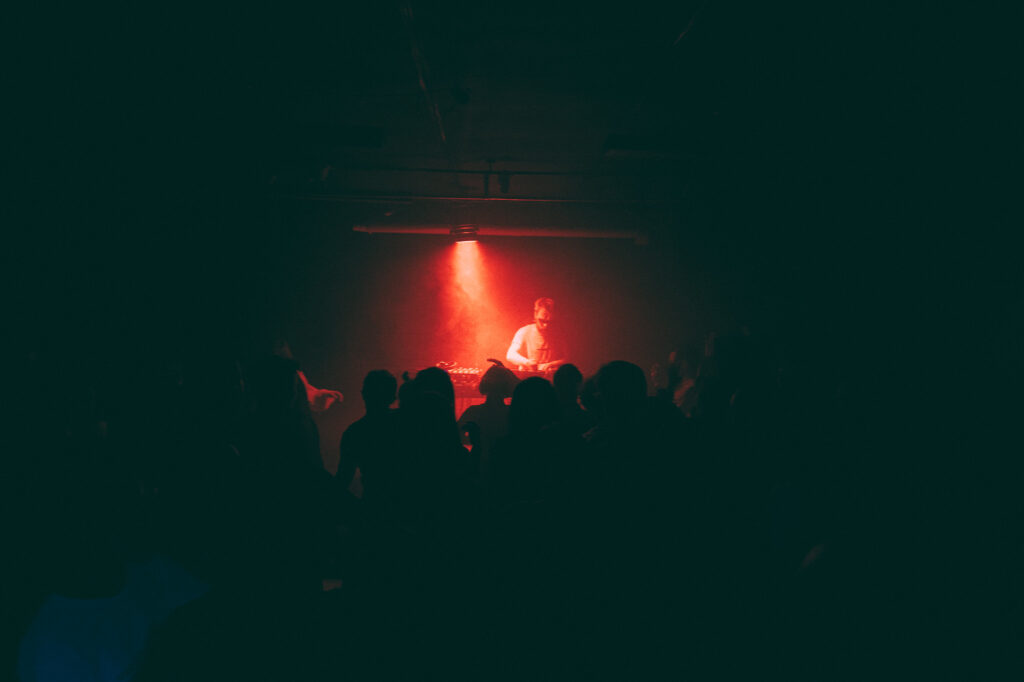
How have ‘ethno-raves’ in Kyiv helped you and your fellow Ukrainians through this time of war?
For most of our audience, CMYK is their first encounter with tradition, and our task is to spark their curiosity and to inspire them to dive deeper into it. As Herman, one of the CMYK team members, puts it: “I joined CMYK so that all my friends — through different media — could come to love what I love so much…traditional music.”
We all share that sentiment. And it feels like now is the best time to share this love for traditional culture, as many Ukrainians are seeking to rediscover their identity.
What are the main challenges of organising and putting on music events during wartime in Kyiv?
A lot can go wrong, so you just try to balance the risks — keeping in mind air alerts, blackouts, and the need to make the space comfortable for veterans. For me, it’s hard to map the main challenges, because I started organizing events after the full-scale invasion from Russia, and since then have never been to music festivals outside Ukraine.
But maybe one of the hardest parts is finding the motivation to keep doing music events during the war. You keep asking yourself: is this really the right thing to do? And how long will I be doing it?
How have live music events, raves, and the music scene in general changed in Ukraine since February 2022?
The main thing, I guess, is that the scene constantly renews itself. Experienced professionals are shifting their cultural projects toward serving the army. At the same time, there are places like Spaska in Kyiv or Nyzhniy Zal in Lviv, where you can start your event with no budget. That’s how many young people begin their careers in music and culture — and sometimes these initiatives grow into something bigger, like a festival or even an institution.
Which of your songs best expresses the last 3 years for you, and why?
This one…
It’s dedicated to the memory of Ukrainian journalist and soldier Alla “Ruta” Pushkarchuk, who had served her country since 2014 and was killed by russian strike in 2024.
“We keep losing the bravest, the most beloved, and the most educated among us.”
How do you envision the future of the rave scene in Ukraine over the next few years, and after the war?
Actually, I don’t really try to envision it — there are too many variables in that equation. We live in a state of constant unpredictability, so we just do what we do and try to do it as best we can. I also feel that CMYK is closer to the world music scene in Ukraine, and I think that scene is only beginning to gain attention. In the next few years, this market will grow and develop a lot.
If you could give one message to independent artists across the rest of Europe, what is that message?
Never work with Russians, otherwise they will bring war to your home.
It’s clear that Kyiv’s ethno-rave scene is as much about upholding Ukraine’s traditions and sense of national identity, as it is about resisting the invasion of their country and suppression of their culture by Russia.
Zbyten left us with a very striking message for independent artists across Europe…
“If you are truly independent, be ready to fight for your independence.”